
Every "best scholarships" list on the internet is really the output of somebody's finder. Somebody picked a database, filtered it, and ranked what came out. So here is our version, with the working shown: this is what the best scholarships for international students in 2027 look like when you run them through a dataset of 494 scholarships and count where they actually sit.
The map comes first: five countries hold 77 percent of the list
Before ranking individual awards, look at the geography. Of the 494 scholarships in our dataset, 154 are hosted in the USA, 70 in China, 61 in the United Kingdom, 52 in Australia and 43 in Canada. Those five countries alone account for 380 scholarships, roughly 77 percent of everything a finder can surface. The Netherlands and Germany follow with 12 each, then a long tail of countries with a handful of entries each.
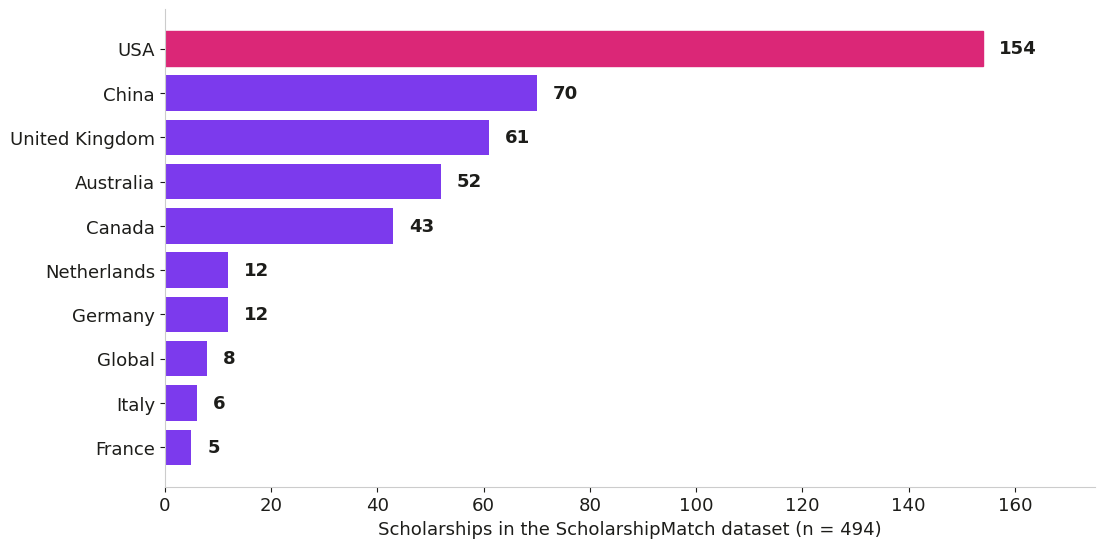
That concentration is the single most useful fact a scholarship finder can teach you. If your target country is outside the top five, your shortlist will be short no matter how good the tool is, and your strategy has to change: you compete for a small number of national schemes instead of browsing hundreds of university awards. If your country is inside the top five, the problem flips. You are not short of options, you are short of filters.
The 10 worth your time
With the map in mind, the names that keep surviving every filter are the big national and university schemes. Fulbright Foreign Student Program (USA) funds graduate study with country deadlines that vary by home country. Australia Awards covers full tuition, living costs and return travel. DAAD Postgraduate (Germany) pays around 992 euro a month plus insurance and a travel allowance. MEXT (Japan) covers tuition plus roughly 144,000 yen a month. Eiffel Excellence (France) pays 1,181 euro a month at masters level. Commonwealth Shared (UK) funds full masters study for students from developing Commonwealth countries. Erasmus Mundus (Europe) funds a full joint masters plus 1,400 euro a month. Knight-Hennessy at Stanford funds any graduate program in full, with a stipend on top.
Notice what that shortlist is made of: mostly government schemes and a few flagship university programs. That is not an editorial preference. It is what the data looks like when you filter 494 entries down to awards that cover most of the cost of a degree. University level partial awards are far more numerous, but they rarely change whether you can afford to go.
Who runs the 494, and what the long tail teaches
One more cut of the data changes how you should hunt. By provider, universities run 354 of the 494 scholarships, governments 89, private and NGO providers 39, intergovernmental bodies 10 and corporations just 2. The famous national schemes dominate the headlines, but nearly three quarters of the actual pool is university money, posted on university pages, with university deadlines. A finder that only indexes national portals is missing most of the dataset before it starts.
Then there is the tail. Beyond the top seven countries sit 90 scholarships spread across 39 other country labels, most with one to five entries each. If your heart is set on one of those countries, no finder can manufacture options that do not exist. What it can do is tell you quickly that the pool is thin, so you can widen to regional or global schemes, the 8 entries in the dataset open worldwide, instead of refreshing the same three results for a month. Honest scarcity is a feature. A shortlist of three real options beats a padded list of thirty you cannot legally touch.
How scholarship finders actually build a shortlist
A good finder does three things in order. First, eligibility: nationality, degree level and field cut the 494 down to a list you can legally apply to. Second, money: our dataset shows only 248 of the 494 publish an award amount at all, so a finder that sorts by published amounts is already working with half the picture. Third, timing: only 185 carry a machine readable deadline, which is why deadline tracking separates serious tools from blog listicles. If a finder cannot show you its filters, it is showing you an advertisement, not a shortlist. The top 5 scholarship finder apps we compared differ mostly in how honestly they handle those three steps.
Run the finder on your own profile
ScholarshipMatch hand-matches your profile against this dataset: your nationality, level and field against the eligibility fields, with deadlines attached, for $9.99 one-time per search. Run it once you know your target countries, because the map above says the country choice decides how much a finder can do for you. For the funding end of the spectrum, see our count of what fully funded actually covers across the same dataset.
Sources: EducationUSA, DAAD