
A scholarship tracker app earns its keep in about eight weeks of the year. That is not an insult; it is what the deadline data says. We counted every dated scholarship in our dataset of 494, and the deadlines do not spread politely across the calendar. They pile up, and the pile is the whole reason tracking tools exist.
The pile: 46 deadlines in March, none in August
Of the 494 scholarships in the dataset, 185 carry a machine readable deadline. Four flagship records with disputed dates are excluded from this count, leaving 181 dated scholarships. March holds 46 of them, a quarter of the entire year. January holds 32 and February 24, so the first quarter alone accounts for 102 deadlines, 56 percent of the total. June adds 17 and November 16. August holds none at all.
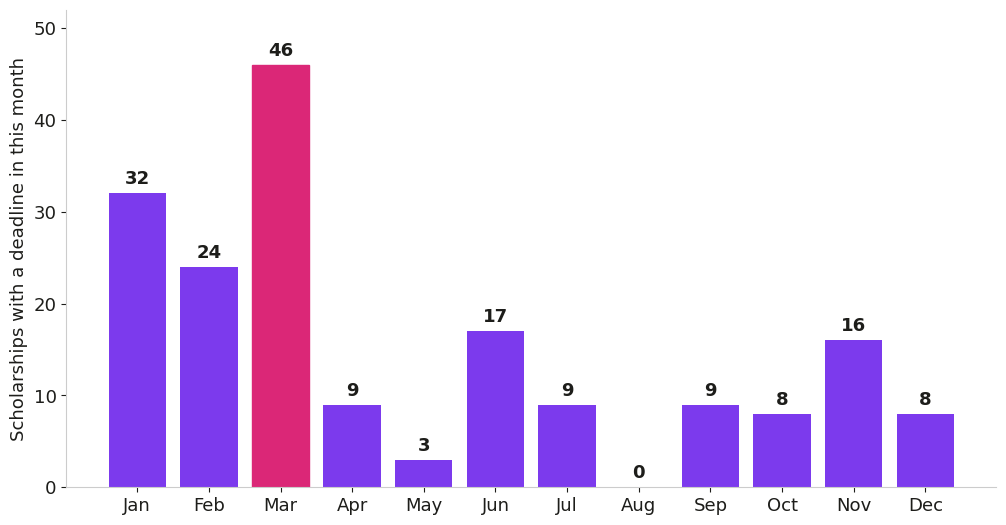
Read that chart as a workload forecast. If you are applying seriously, your documents, transcripts and recommendation letters have to be ready by December, because the January to March wall does not care when you started. A tracker that treats every month the same is lying to you about the shape of the year. The September to February window holds 97 of the 181 deadlines, which is why experienced applicants talk about "the season" as if it were weather.
The quiet months are a gift, if you use them
Split the 181 deadlines by quarter and the rhythm gets clearer. The first quarter holds 102 deadlines. The second holds 29, the third just 18, and the fourth 32. May has only 3 deadlines in the entire dataset and August has none, which makes late spring and summer the natural building season: transcripts requested, tests booked, referees briefed, drafts written. The applicants who look calm in February did their paperwork in July.
A good tracker respects that rhythm. It should go quiet when the calendar is quiet and get loud in November, when the January to March wall is close enough to matter but far enough to fix problems. If your app buzzes at the same volume all year, it has a notification strategy, not a tracking strategy.
Ten trackers, one rule
| App | Tracking strength | Price |
|---|---|---|
| ScholarshipMatch | Hand-matched list + push deadlines | $9.99/search |
| Scholly | US deadlines | Subscription |
| Going Merry | US applications + deadlines | Free |
| Bold.org | Donor scholarship dates | Free |
| Yocket | Community deadline threads | Free |
| Buddy4Study | India scholarship dates | Free |
| WeMakeScholars | Loan + scholarship timelines | Free |
| LeapScholar | Counsellor-managed dates | Free (funnel) |
| IDP | Country-wise timelines | Free (commission) |
| Studee | UK deadline guidance | Free |
The rule from our earlier comparison still stands: the app should know YOUR deadlines, not list everyone's. If it cannot filter by your nationality and degree level, it is a calendar, not a tracker. A generic calendar shows you all 46 March deadlines. A tracker shows you the handful that survive your eligibility filters, and starts nagging you in November. The tools above differ less in their lists than in that filtering step, which is why our free tracker apps comparison scores the filters before the features.
What to demand from a tracker
Three things. First, deadlines attached to a matched list, not a public feed: the date only matters if the scholarship is one you can actually win. Second, reminders that start early enough to fix documents, which given the March pile means alerts in December and January, not the week before. Third, an honest export: your list should leave the app with you as a file or an email, because you will outlive any single app's business model. Push alerts help, and we compared the best of them in our scholarship alert apps roundup, but an alert about the wrong scholarship is just noise with a vibration.
The tracker built on this dataset
ScholarshipMatch works the other way round from a calendar: it hand-matches your profile first, then attaches the deadlines of the scholarships you are actually eligible for, for $9.99 one-time per search. Matched first, tracked second. Given that 56 percent of dated deadlines land in a single quarter, that order is the difference between a plan and a panic.
Sources: EducationUSA