
Most merit scholarship advice ranks programs by fame. A finder app should rank them by money, because money is the part you can verify. So we took the 494 scholarships in our dataset, pulled the 248 that publish an award amount, and looked at what merit money for a masters abroad actually looks like when you sort by size instead of by brand.
The money, in bands: the median published award is $15,000
Here is the distribution. Six scholarships publish amounts between $1,000 and $4,999. Fifty-one sit between $5,000 and $9,999. The biggest band by far is $10,000 to $24,999, with 128 scholarships. Forty-five publish $25,000 to $49,999, and 18 publish $50,000 or more, topping out at $300,000. The median published award across all 248 is $15,000.
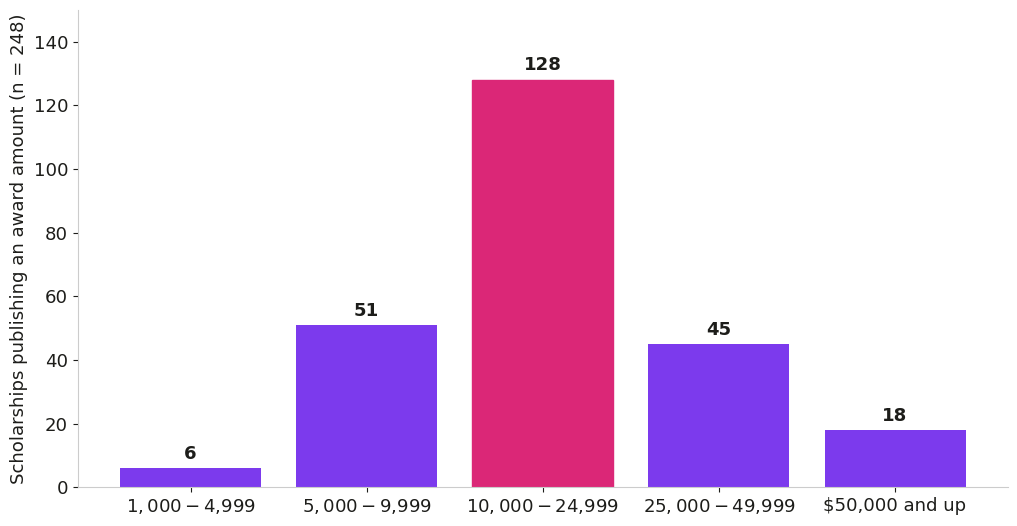
Two lessons hide in that shape. First, the fat middle is real: half of all published amounts land between $10,000 and $25,000, which covers a serious slice of tuition in most countries but rarely the whole degree plus living costs. Second, half the dataset publishes no amount at all. A finder that only sorts the 248 with numbers will quietly hide the other 246, including some fully funded schemes that describe funding in words instead of figures. Sorting by amount is the right instinct; sorting ONLY by amount is a trap.
The names at the top of the merit pile
The established merit benchmarks still anchor the top band. Knight-Hennessy at Stanford is a full ride for any graduate program, leadership-weighted. Rhodes at Oxford covers full cost plus a stipend and needs institutional endorsement. Clarendon at Oxford covers full tuition plus living costs, with automatic consideration when you apply. ANU Chancellor's International covers 25 to 50 percent of tuition for masters coursework. Note the pattern: merit deadlines hide inside university applications, usually December to January. You do not apply twice; the admission application IS the scholarship application. Tick the box, write the extra essay, move on.
The masters slice, counted on its own
Narrow the dataset to the 160 scholarships open at masters level and the shape shifts a little. Eighty-five of the 160 publish an award amount, a better hit rate than the dataset as a whole, and 45 of the 160 are tagged fully funded. So a masters hunter faces a friendlier pool than the headline numbers suggest, but still one where nearly half the entries hide their money. It also means stacking is a real strategy: 179 of the 248 published amounts across the dataset sit under $25,000, and two mid-size university awards plus a departmental grant can quietly add up to more than one famous full ride that ten thousand people are chasing.
The practical move is to sort twice: once by amount, to see the money clearly, and once by coverage, to catch the fully funded entries that publish no figure at all. Any tool that only offers the first sort is doing half the job.
How a finder app should sort your masters list
Amount first, then coverage type, then deadline. Amount, because $15,000 against tuition you can price is a plan, while "generous funding" is a mood. Coverage type, because 96 scholarships in this dataset are tagged fully funded and they break the amount logic entirely: full funding with no published figure beats a $20,000 partial award almost every time. Deadline, because 160 scholarships in the dataset are open at masters level and the merit ones cluster in the same December to January window as admissions. Our comparison of free vs paid scholarship apps found that the paid tools earn their fee exactly here, in sorting quality, not in list size. Doctoral applicants face a different shape again, covered in our PhD stipend breakdown.
Sort your own list
ScholarshipMatch matches your profile against the full 494, amounts and fully funded flags included, and returns the eligible list with deadlines attached for $9.99 one-time per search. Bring your target tuition figures with you: the median $15,000 award means something very different in Germany than it does in the United States.
And keep the receipts: when an award publishes no amount, note the funding wording word for word in your spreadsheet. "Full tuition" and "tuition support" sound like cousins and pay like strangers, and the difference only shows up when the invoice arrives.
Sources: EducationUSA