
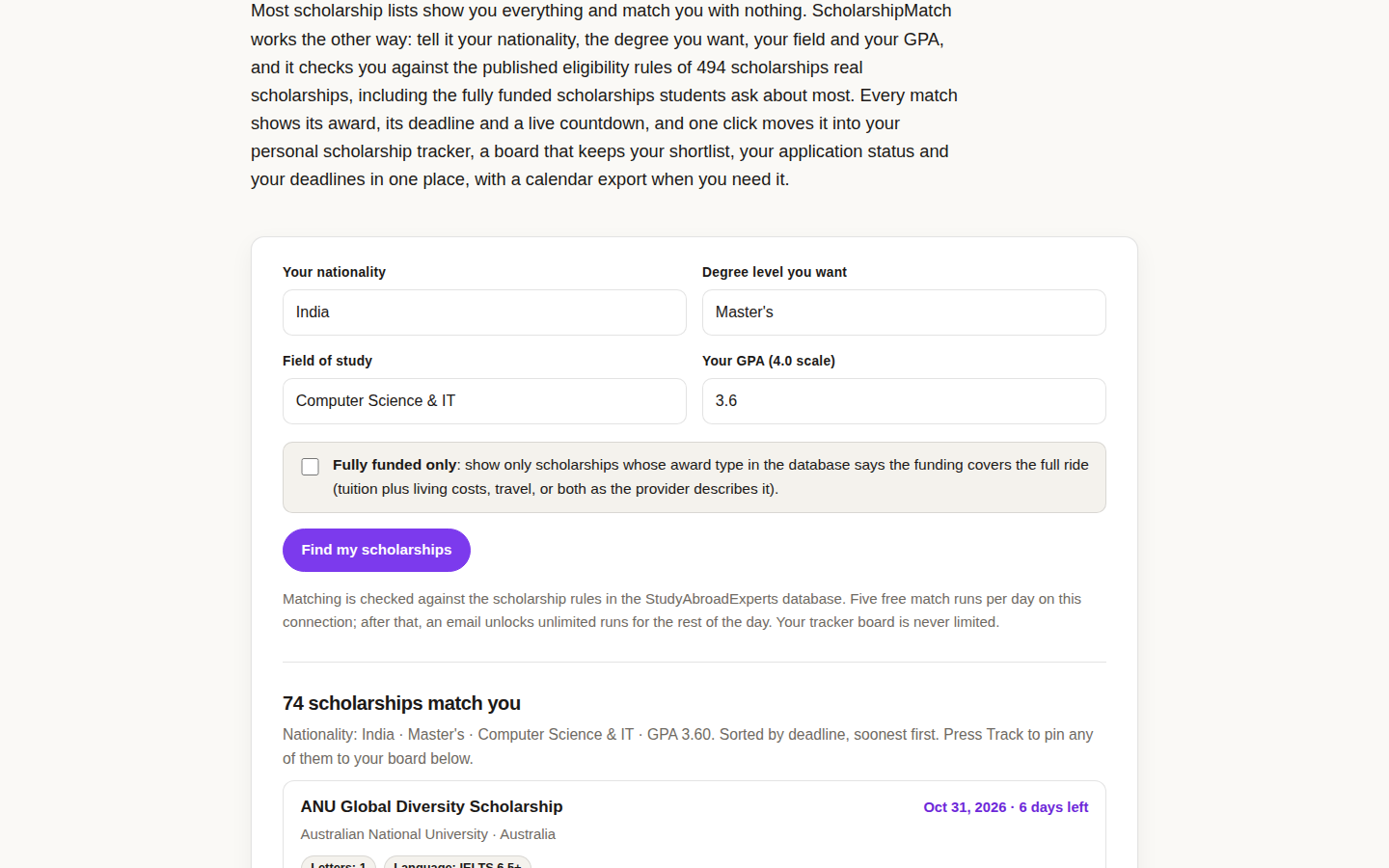
The new scholarship finders ask for one sentence: your level, your field, and where you want to study. ScholarshipFinderAI, the top result for "ai scholarship finder", takes exactly that input, and behind the sentence sits the same machinery every matcher uses, ours included: your details are turned into filters, and the filters are run over a structured dataset. Understanding what the dataset actually contains is the difference between using a finder well and believing it too much.
What the matcher compares
A match is an eligibility test, run field by field. Destination: our dataset covers 494 scholarships, led by the USA with 154, China with 70, the UK with 61, Australia with 52 and Canada with 43. Level: the records describe master's study most often (160 records), then bachelor's (143) and doctoral (121). Provider: 354 come from universities and 89 from governments, which matters because government awards carry nationality rules an AI cannot waive. When a finder says a scholarship matches you, it means no recorded rule excludes you. That is a strong claim about eligibility and no claim at all about your chances.
What it cannot see
The honest limits are in the data itself. Award amounts are recorded for only 248 of our 494 scholarships, so a matcher cannot rank your shortlist by money without inventing figures. Deadlines are recorded for 185, which means the other 309 matches arrive with homework attached. Field-of-study detail is thin across every dataset in this niche, because programs describe fields in prose, not codes. And no matcher reads your essays, your references, or the difference between meeting a GPA floor and being competitive at it. A finder that explains its matches, showing which of your details each scholarship matched on, is telling you the truth about what it did. One that prints a percentage is decorating.
Frequently asked questions
Will an AI finder surface scholarships I would miss on my own?
Yes, mostly across borders. Students search their home country's famous awards and stop; a dataset holds the university-funded and intergovernmental programs nobody markets, and in our data the long tail is real: 39 private and NGO providers and 10 intergovernmental ones sit alongside the big government names.
Why did a match arrive with no amount and no deadline?
Because the program publishes them in prose, in a PDF, or not at all, and the dataset records only what it can structure. Treat the match as an eligibility lead and take the amount and the date from the program's own page.
Should I trust the deadline a finder shows me?
As a reminder to check, never as the date itself. Harvested deadlines drift, programs move them, and some programs in circulation no longer exist. Our own rule, printed wherever the tool shows a date, is that the program page is the only source that counts.
For the comparison of dedicated matcher apps, see what matcher apps do and where they fall short. To run the machinery yourself, ScholarshipMatch matches your profile against the same 494-scholarship dataset counted here, shows its working, and hands the survivors to a tracker board, which is where, as our tracking guide argues, the applications are actually won.